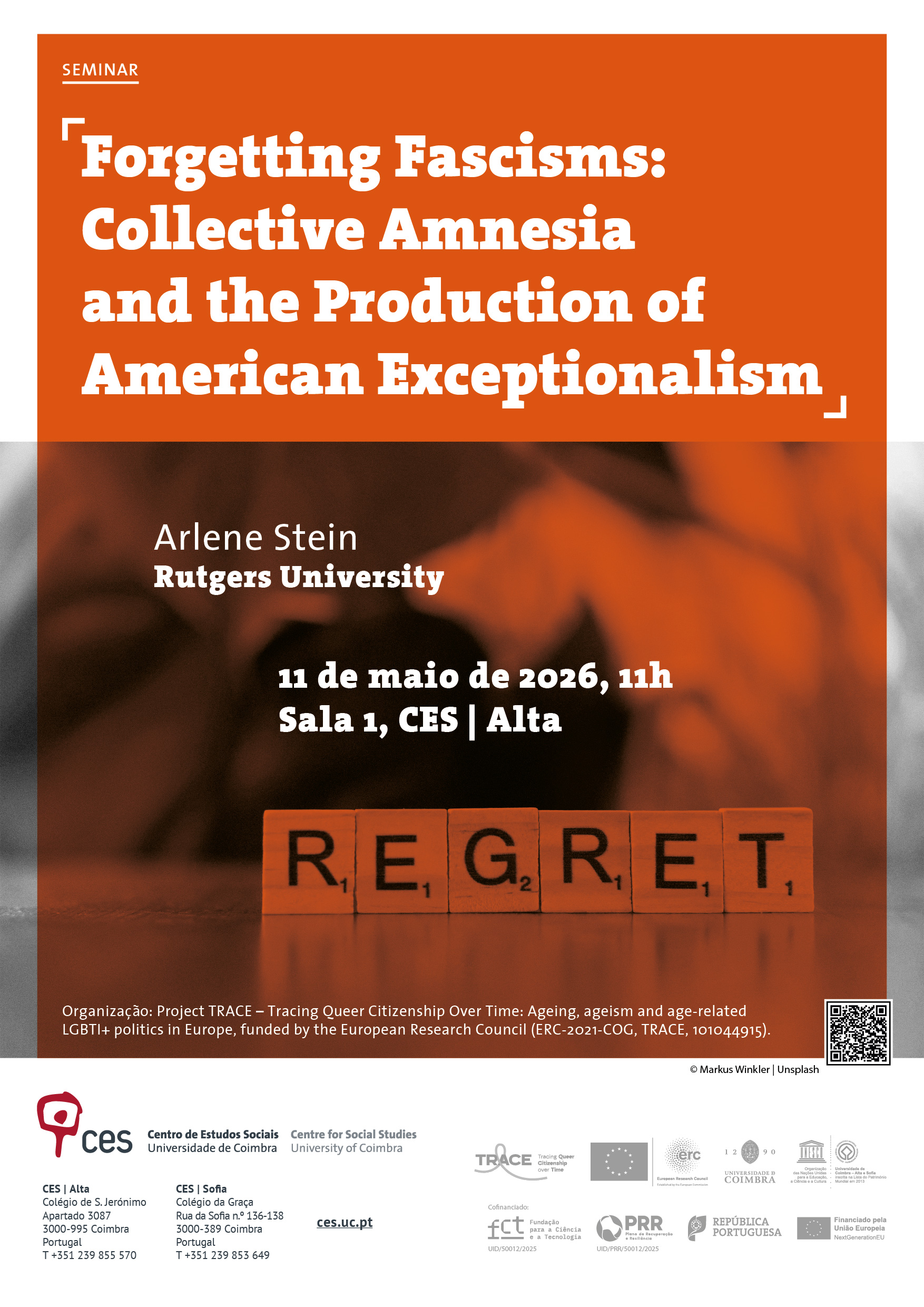

Seminário
Forgetting Fascisms: Collective Amnesia and the Production of American Exceptionalism
Arlene Stein (Rutgers University)
11 de maio de 2026, 11h00
Sala 1, CES | Alta
During the 1930s, fascist ideologies and organizations were in vogue not only in Europe but also in the United States. Interwar American fascists sought to implement a White/Christian ethnostate and were often willing to use violence to achieve their goals. Yet today, this history is little known to Americans. In this talk, I analyze oral histories with young Americans who grew up during the interwar period to account for this forgetting. Without a collective memory of US fascist movements, I argue, the contemporary power of authoritarian ideas and movements is exceedingly difficult for Americans to grasp.
Nota biográfica
Arlene Stein (Distinguished Professor, Rutgers University, Department of Sociology) research focuses on the intersection of gender, sexuality, culture, and politics, with particular interests in the sociology of collective memory, emotions, and identities. The author or editor of nine books, she received the American Sociological Association’s Simon and Gagnon Award for career contributions to the study of sexualities. Her latest book is Unbound: Transgender Men and the Transformation of Identity (Pantheon, 2018). She is also the author ofThe Stranger Next Door, an ethnography of a Christian conservative campaign against lesbian/gay rights, which explores clashing understandings of religion and sexuality in American culture; it received the Ruth Benedict Book Award. Her book Sex and Sensibility examines generational shifts in lesbian identities. Reluctant Witnesses: Survivors, Descendants, and the Rise of Holocaust Consciousness (Oxford, 2014), looks at how children of survivors became narrators of their parents’ stories of genocide. Going Public: A Guide for Social Scientists (J. Daniels, coauthor), is a guidebook for publicly engaged scholars. She has taught at the University of Essex and the University of Oregon.
Organização: Projeto TRACE - Tracing Queer Citizenship over Time | Ageing, ageism and age-related LGBTI+ politics in Europe (ERC, Grant Agreement 101044915)