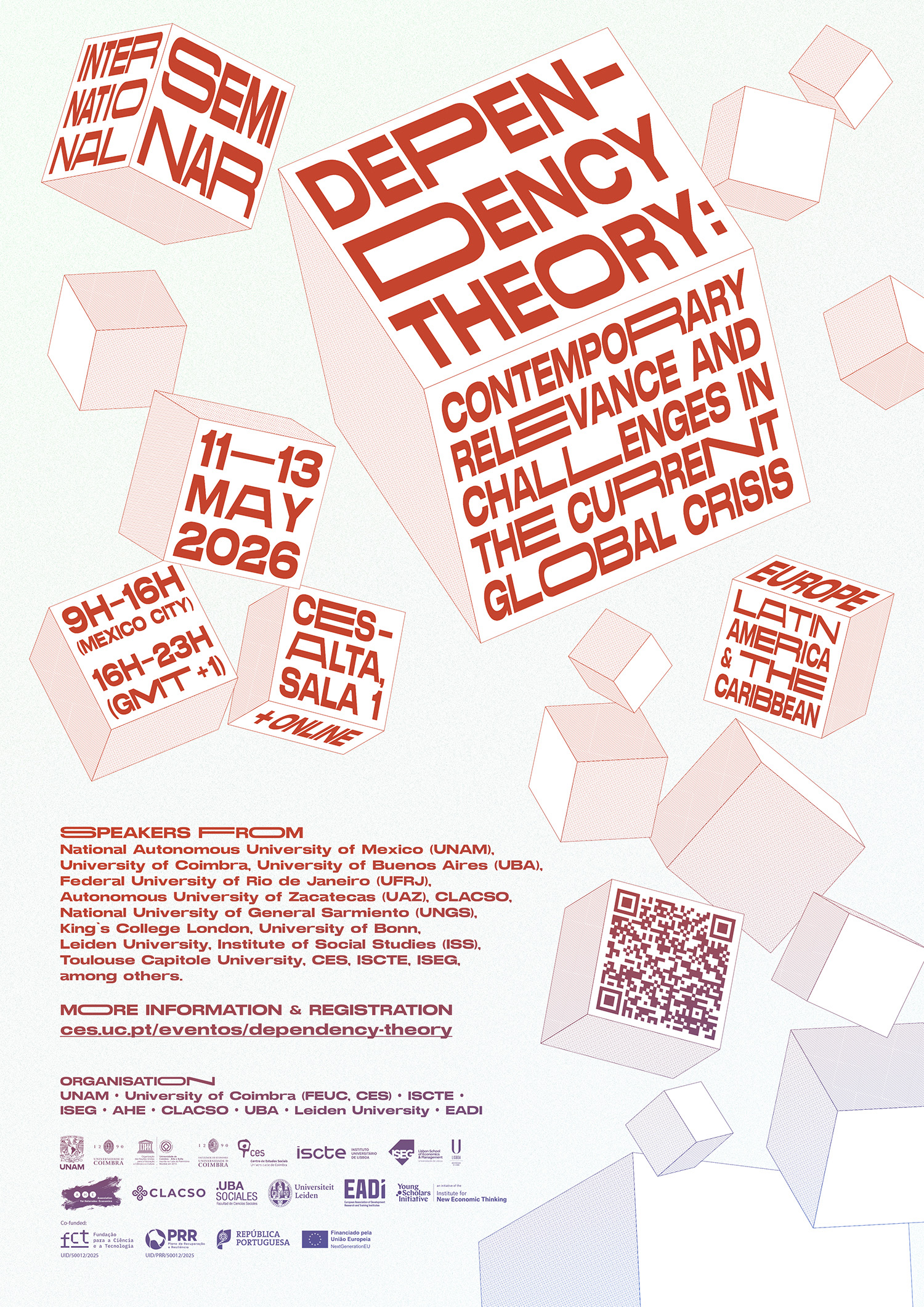

Seminário Internacional
Dependency Theory: Contemporary Relevance and Challenges in the Current Global Crisis
11-13 de maio de 2026 || 9h00-16h00 (Fuso horário da Cidade do México) [16h00-23h00 | GMT+1]
Sala 1, CES | Alta + Online
A bi-continental meeting: Europe–Latin America and the Caribbean
_____________________________________________________
In a context shaped by the reconfiguration of the world order, the intensification of geopolitical disputes, the structural financialisation of the economy, the ecological crisis, and the deepening of social inequalities, Dependency Theory has once again become an indispensable perspective for understanding the dynamics of contemporary capitalism. Far from constituting a closed chapter in Latin American thought, the dependency approach offers decisive analytical tools for interpreting the current global crisis and its implications for Latin America and the Caribbean.
This international seminar, bi-continental in scope and held in a hybrid format, brings together leading scholars with the aim of debating the contemporary relevance, renewal, and future trajectory of Dependency Theory in the twenty-first century.
Within this framework, the programme will also include the presentation of Decolonizing Economics: An Introduction (Devika Dutt, Carolina Alves, Surbhi Kesar, and Ingrid Harvold Kvangraven). The book examines the Eurocentric foundations that have shaped the economics discipline and constrained its capacity to engage with phenomena such as structural racism, uneven development, the climate crisis, and labour relations. It proposes “decolonising” economics by challenging the norms of neutrality and objectivity from which the discipline often claims to speak, and by opening space for approaches that take structural power, exploitation, and colonial legacies seriously. This session will include discussion by leading thinkers from the Latin American tradition of Dependency Theory and is conceived as a direct dialogue with the seminar’s thematic strands—particularly in rethinking the political economy of global capitalism from non-Eurocentric frameworks.
Registration is free, but mandatory.
Thematic strands
Strand 1. The historical development and contemporary relevance of Dependency Theory
This strand addresses the historical development and contemporary relevance of Dependency Theory, examining its main analytical categories, internal debates, and explanatory power in the face of recent transformations in global capitalism.
Strand 2. (Neo-)imperialisms, geopolitical tensions, and international economic relations from a dependency perspective
This strand analyses (neo-)imperialisms, geopolitical tensions, and international economic relations from a dependency perspective, interrogating global power configurations, inter-power rivalry, and the place of the periphery within the emerging world architecture.
Strand 3. New theoretical and methodological horizons: Dependency Theory as a framework for the contemporary world structure
This strand explores new theoretical and methodological horizons to consolidate Dependency Theory as an analytical framework for today’s world structure, engaging with debates on financialisation, extractivism, global value chains, the ecological crisis, and transformations of work.
More than a commemorative exercise, this seminar advances a strategic discussion: to think dependency today is to think about the conditions of possibility for sovereignty, development, and emancipation in a contested world.
Latin American Speakers:
• Adrián Sotelo, National Autonomous University of Mexico (UNAM)
• Ana Grondona, University of Buenos Aires (UBA)
• Claudio Katz, University of Buenos Aires (UBA)
• Diego Giller, National University of General Sarmiento (UNGS)
• Emir Sader, Federal University of Rio de Janeiro (UFRJ)
• José G. Gandarilla, National Autonomous University of Mexico (UNAM)
• Juan Manuel Contreras, Autonomous University of Mexico City (UACM)
• Marcelo Dias Carcanholo, Fluminense Federal University (UFF)
• Mariano Treacy, National University of General Sarmiento (UNGS)
• Mónica Bruckmann, Federal University of Rio de Janeiro (UFRJ)
• Nildo Ouriques, Federal University of Santa Catarina (UFSC)*
• Raúl Delgado Wise, Autonomous University of Zacatecas (UAZ)
• René Ramírez, Latin American Council of Social Sciences (CLACSO) and National University of the Arts (UNA)
• Roberto Escorcia Romo, Metropolitan Autonomous University (UAM)
• Sebastián Sztulwark, National University of General Sarmiento (UNGS)
European Speakers:
• Andrew Fischer, International Institute of Social Studies (ISS)
• Carla Coburger, University of Duisburg-Essen (UDE)
• Devika Dutt, King's College London (KCL)
• Fabio Maldonado, King's College London (KCL)
• Ingrid Harvold Kvangraven, King's College London (KCL)
• Jonas Van Vossole, Centre for Social Studies (CES)
• Luís Mah, University Institute of Lisbon (ISCTE)
• María Gabriela Palacio, Leiden University (LU)
• Patrick Mokre, Vienna University of Economics and Business (WU Vienna)
• Rogelio Madrueño, University of Bonn
• Rui Costa Santos, University of Granada (UGR)
* To be (re)confirmed.
Organising Committee: Ernesto Nieto-Carrillo (FEUC), René Ramírez (CLACSO-UNA), Adrián Escamilla Trejo (UNAM), María Gabriela Palacio (LU), Ana Cordeiro Santos (CES), Roberto Ruiz Blum (FEUC), Gabriela Riera (ISCTE).
Institutional Organisers:
National Autonomous University of Mexico (UNAM) – México
Faculty of Economics of University of Coimbra (FEUC); Centre for Social Studies (CES); University Institute of Lisbon (ISCTE); Lisbon School of Economics and Management (ISEG) – Portugal
Association for Heterodox Economics (AHE) – United Kingdom
Latin American Council of Social Sciences (CLACSO)
University of Buenos Aires (UBA) – Argentina
Latin American Studies (LAS) of the Leiden University – Netherlands
European Association of Development Research and Training Institute (EADI)
Young Scholar Initiative of the Institute for New Economic Thinking (YSI-INET)
_________________________
Esta atividade realiza-se através da plataforma Zoom, com inscrição obrigatória. No entanto, está limitada ao número de vagas disponíveis.
Agradece-se que todas/os as/os participantes mantenham o microfone silenciado até ao momento do debate. A/O anfitriã/ão da sessão reserva-se o direito de expulsão da/o participante que não respeite as normas da sala.
As atividades abertas realizadas em formato digital, como esta, não conferem declaração de participação.