
ECOSOC - Oficina de Ecologia e Sociedade
Workshop
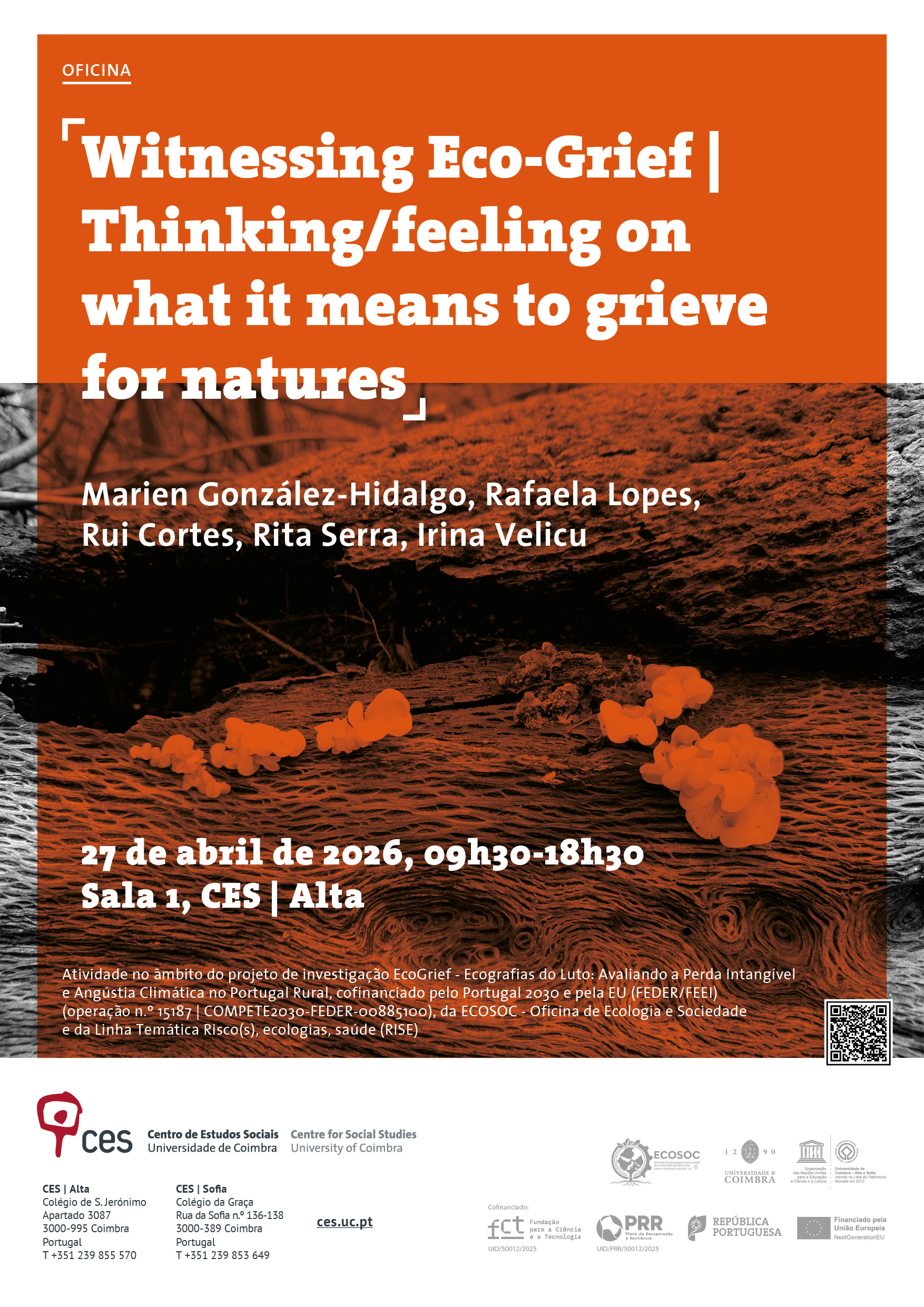
Witnessing Eco-Grief | Thinking/feeling on what it means to grieve for natures
April 27, 2026, 09h30-18h30
Room 1, CES | Alta
Environmental changes impact the well-being of communities: material losses are closely linked to loss of ways of life, territories, knowledge as well as dignity or belonging. Such losses are both traumatic and unjust. The tragedy of a fire or flood often coincides with inequities in land planning or health access, which amplifies the harms, especially for vulnerable communities. It is expected that climate-related disasters become more frequent, a cause of psycho-terratic distress as the next biggest challenge for public health.
Defined as a mental health response to loss of meaningful landscapes and species due to environmental/climate change, Eco-Grief has been documented in various contexts: reef or ice loss, wildfires, biodiversity loss, floods or heatwaves. Communities all around the world testify the labor of juggling with sorrow, isolation, humiliation, anger, stress, shame, power(lessness) or hope(lessness) especially in contexts of war, resources conflicts, poverty, or precarity. This project wishes to contribute to a better understanding of the individual/collective processes of embodied lived experience of distress, solastalgia, and eco-grief in rural Portugal. We invite the broader public, ecologists, psychologists, biologists, and social scientists to discuss together the constellation of emotions implied by eco-grief and their socially transformative power.
ECOGrief integrates ecopsychology, political ecology and economy by building a new interdisciplinary index to measure Environmentally-induced Distress and Eco-grief based on evidence of culturally meaningful idioms of Intangible Loss & Damage in rural Central Portugal thus contributing to a better understanding of Public Mental Health & Restorative Socio-Environmental Justice in the context of climate change and the green transition.
We wish to organize a roundtable debate on climate changes in rural Portugal, with the aim to discuss and co-produce an interdisciplinary analytical framework and methodological tools to better understand traumatic experiences of loss and ecological grief.
Background reading for debate > Velicu, I., Piccardi, E. G., Delibas, H. I., & Ogrezeanu, A. (2026). Rural Eco-Grief: Insights from Portugal and Romania. Emotion, Space and Society, 58, 101152
Programme
Welcoming words, registration 9.30 - 9.45
Project presentation: 9.45-10.00
Facilitated Debate I: What is EcoGrief? 10.00 - 12.30
Lunch
Facilitated Debate II: How can EcoGrief be researched? 14.30 - 17.00
Tea break: 17:00 - 17.15
Conclusions: Rural Eco-Grief in Portugal 17.15 - 18.00
Speakers
Rafaela Lopes | Currently a Clinical Psychologist in Coimbra, she has developed a grief support programme. She is also a psychologist in the Psychosocial Support Teams of the National Civil Protection Authority that provide support to firefighters, family members and other populations in crisis scenarios. Works for ULS Coimbra.
Marien González Hidalgo | Researcher at the Department of Urban and Rural Development of the Swedish University of Agricultural Sciences. Her work is inspired by political ecology and environmental justice, and analyses the role that emotions and healing practices play in environmental disasters, conflicts and mobilisations.
Rui Cortes | Environmental Science, Department of Landscape and Forest Sciences, Universidade de Trás-os-Montes e Alto Douro, (UTAD - Portugal), and senior researcher at the Center for Environmental Technologies. Dr. Cortes teaches graduate courses on Aquatic Ecology, River Restoration, Riparian Vegetation, and Environmental Impact Assessments.
Rita Serra | PhD applied biologist and Researcher at CES since 2008 in topics related to the production of meaningful science. She is an expert in community-based research and governance of community forests. Since finding out she (and other members of the family) are neurodivergent, she collaborates with a self-advocacy association of autistic people in Portugal, the APVA, in participatory research with autistic people. Currently she is the coordinator of AUTICORPOS 2.0: Improving the mental health and wellbeing of autistic people, cofunded by the INR, I.P and led by the APVA.
Activity within the research project EcoGrief: EcoGraphies of Grief: Assessing Climate Intangible Loss and Distress in Rural Portugal, co-funded by the Portugal 2030 and by the European Union through The European Regional Development Fund (ERDF) - European Structural and Investment Funds (ESIF) (operation n.º 15187, operation code: COMPETE2030-FEDER-00885100), and coordinated by Irina Velicu.