
ECOSOC - Oficina de Ecologia e Sociedade
Seminar
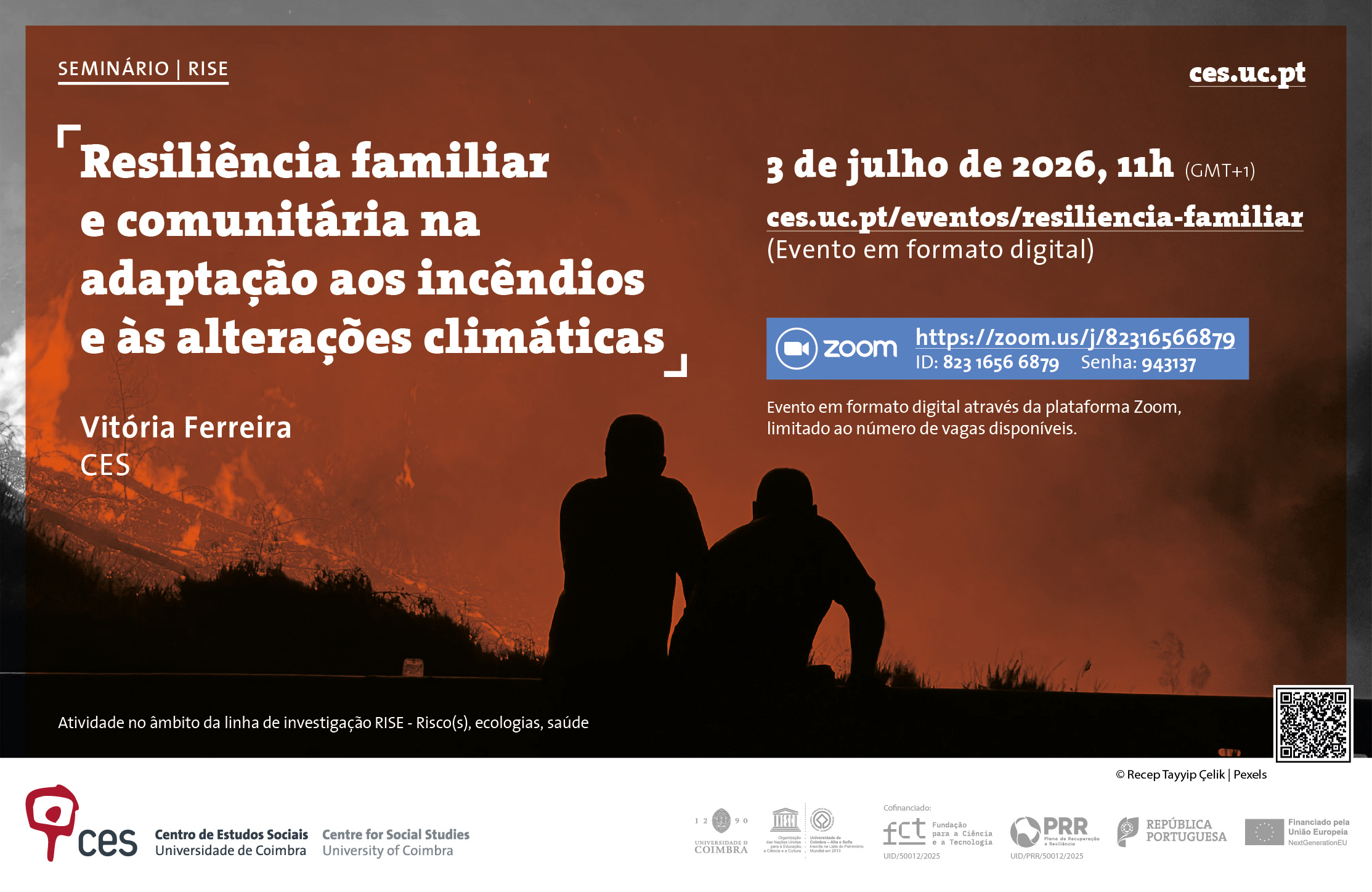
Family and community resilience in adapting to wildfires and climate change
Vitória Ferreira (CES)
July 3, 2026, 11h00 (GMT+1)
Evento em formato digital
The research to be presented explores resilience to wildfires linked to climate change in a country whose history has been marked by intense wildfires that affect families, communities, and ecosystems, resulting in significant economic, environmental, and psychosocial impacts. Despite the increase in the frequency and intensity of wildfires linked to climate change, research on resilience to wildfires remains limited, focusing primarily on their negative effects and on individual resilience. However, an understanding of systemic resilience processes can help to strengthen prevention, preparedness, and response strategies. This PhD project aimed to understand the processes of family and community resilience in the face of wildfires and climate change. It also sought to identify the characteristics that define resilient families and communities, as well as explore processes of adaptation to adversity and ways to promote resilience. The research proposes a conceptualisation of families and communities as resilient agents of change, capable of responding to and adapting to the challenges posed by wildfires and climate change.
The results include the adaptation of the Index of Perceived Community Resilience (IPCR) - a tool for assessing community resilience - to the Portuguese context, and the development and validation of an original instrument, the Climate Change Multidimensional Assessment Scale (CCMAS), which assesses perceptions of climate action from a systemic perspective, covering five psychological dimensions. Processes that strengthen resilience were identified using mixed-methods approaches and an innovative Family Interview on Wildfires (EFI), designed to assess family adaptive processes throughout the wildfire emergency cycle. An integrative analysis of the results led to the development of the Adaptive Resilience Ecosystem (ARE) model, which provides a conceptual framework for understanding how families and communities can prepare for, respond to and adapt to emerging challenges, thereby contributing to broader efforts in disaster preparedness, climate adaptation, and the promotion of resilience.
Bio note
Vitória Ferreira is a PhD candidate at CES and on the Inter-university PhD Programme in Psychology, specialising in Clinical Psychology, with a focus on Family Psychology and Family Intervention, run by the University of Coimbra and the University of Lisbon.
Her PhD project, “Facing the heat: Resilient families and communities adapting to rural wildfires and climate change”, is funded by the Foundation for Science and Technology (Grant 2022.11358.BD). Her research focuses on resilience in the face of adversity, particularly in disaster contexts, exploring the role of families and communities as resilient agents in mitigating and adapting to climate change.
She holds a Master’s degree in Clinical and Health Psychology from the Faculty of Psychology of the University of Lisbon. She is also a psychologist and a full member of the Portuguese Psychologists’ Association, where she is part of the Psychologists’ Network for Crisis and Disaster.
She also participates in initiatives organised by the European Commission and the European Parliament on mental health, democracy, decision-making, and climate education. She is the author of several publications and a speaker at various national and international conferences.
Her research interests include family studies, family intervention, the impact of disruptive events and uncertainty on family life, as well as processes of resilience.
This event forms part of a series of seminars organised by the ‘Risk(s), Ecologies, Health’ (RISE) research group.
_____________________________
This activity will be provided through Zoom platform and does not require registration. Participation is limited to the number of places available > https://zoom.us/j/82316566879 | ID: 823 1656 6879 | Password: 943137
Please keep the microphone on mute until the discussion is open. The host may remove disruptive participants.
Open activities in digital format, such as this one, do not grant a declaration of participation. Such document will only be guaranteed in events with prior registration and regulated access.