
ECOSOC - Oficina de Ecologia e Sociedade
Seminar + Book Presentation
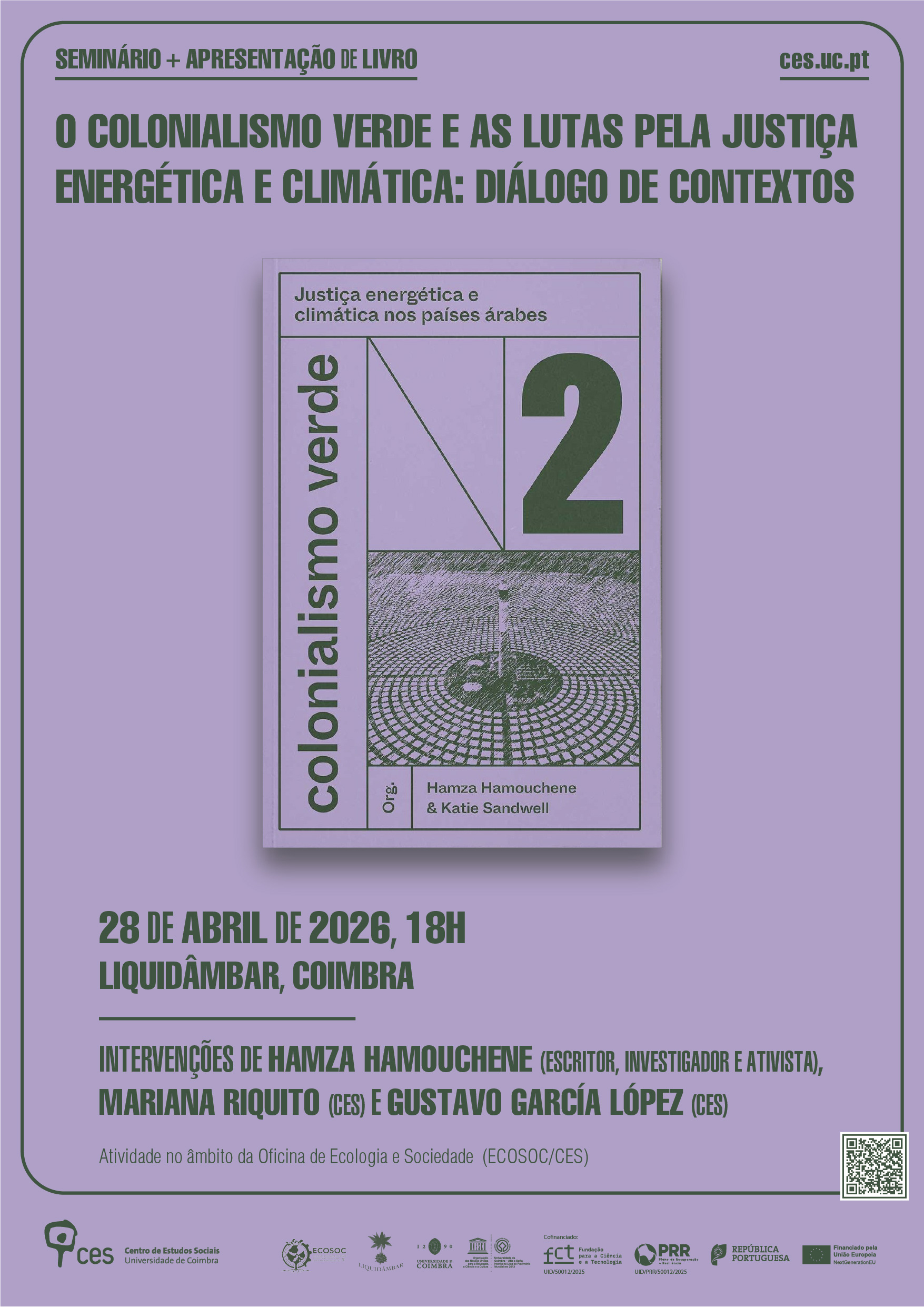
Green colonialism and the struggles for energy and climate justice: A dialogue of contexts
April 28, 2026, 18h00
Liquidâmbar (Coimbra)
The climate crisis is already evident in the Arab region, with droughts, wildfires, heatwaves and floods. In the face of this crisis, ‘green’ transition initiatives are being proposed; however, these initiatives often reproduce existing power relations and extractive dynamics, exacerbating socio-environmental harm and injustices. A genuine transition that is socially and ecologically just requires a break with ‘business as usual’, which protects corporations and authoritarian regimes, and demands the adoption of a radical process of transformation that recognises not only the industrialised West’s historical responsibility for global warming, but also the role of emerging countries in perpetuating this destructive economic order.
In this seminar, we will reflect on these issues in a dialogue drawing on contexts from the Arab and Mediterranean regions, between the author/editor of the book Colonialismo Verde, v. 2: Justiça energética e Climática nos paises árabes (Ed. Elefante, 2025) [Green Colonialism, vol. 2: Energy and Climate Justice in Arab Countries], Hamza Hamouchene, and researchers Mariana Riquito and Gustavo García López, together with other researchers and activists, and the general public, on issues of environmental and climate justice.
The event will seek to answer key questions in the debates on the ‘green’ transition: What would a just transition look like in these regions? Is there scope for a vision of emancipation and informed climate action, driven from the bottom up and non-imperialist? What is the relationship between justice in a ‘green’ economy and democracy and energy self-determination?
Bio notes
Hamza Hamouchene is an Algerian researcher, activist and commentator based in London, as well as a founding member of the Algeria Solidarity Campaign (ASC) and Environmental Justice North Africa (EJNA). He has previously worked for War on Want, Global Justice Now and Platform London on issues related to extractivism, natural resources, food and land sovereignty, as well as climate, environmental and trade justice. He is the author/editor of four books: Dismantling Green Colonialism: Energy and Climate Justice in the Arab Region (2023), The Arab Uprisings: A Decade of Struggles (2022), The Struggle for Energy Democracy in the Maghreb (2017) and The Coming Revolution to North Africa: The Struggle for Climate Justice (2015). He has also contributed chapters to the books Voices of Liberation: Frantz Fanon (2014) and The Palgrave Encyclopaedia of Imperialism and Anti-Imperialism (2016). His other articles have been published in The Guardian, Middle East Eye, CounterPunch, New Internationalist, Jadaliyya, openDemocracy, ROAR Magazine, Pambazuka, Nawaat, El Watan and Huffington Post.
Mariana Riquito is a PhD candidate at the University of Amsterdam and a Junior Researcher at CES, where she collaborates on the GREENPATHS project and co-coordinates ECOSOC (Workshop on Ecology and Society). She holds a degree in International Relations from the Faculty of Economics of the University of Coimbra (FEUC) and a Bachelor’s degree in Political Studies from the Bordeaux Institute of Political Studies (IEP). Mariana Riquito also holds a Master’s degree in International Relations – Peace, Security and Development Studies from FEUC and a Master’s degree in Sociology and Political Science from IEP. Her research and writing focus on the contested arena of the energy transition, exploring debates on extractivism, ecofeminism, ontological pluralism and socio-ecological alternatives, drawing from the case of Covas do Barroso.
Gustavo García López is an engaged scholar, educator and organiser from the islands of Puerto Rico. He has a transdisciplinary background in socio-environmental sciences, combining political ecology and environmental planning and public policy with decolonial studies of Latin America and the Caribbean. His work focuses on transformative eco-social initiatives and movements, bridging ideas of the commons, self-management, and environmental and climate justice. He is currently a Principal Researcher at the Centre for Social Studies of the University of Coimbra, where he is part of the Workshop on Ecology and Society (ECOSOC) and the Risk Observatory (OSIRIS), and coordinates the project EJMapping: Counter-mapping environmental justice conflicts in the European periphery: the case of Portugal. He is also a co-founding member of the political ecology blog Undisciplined Environments and the collective Post-Extractive Futures, and is part of the Ecosocial and Intercultural Pact of the South, a platform that brings together people from various collectives and Latin American countries to develop collective visions and solutions for ecosocial transformation.