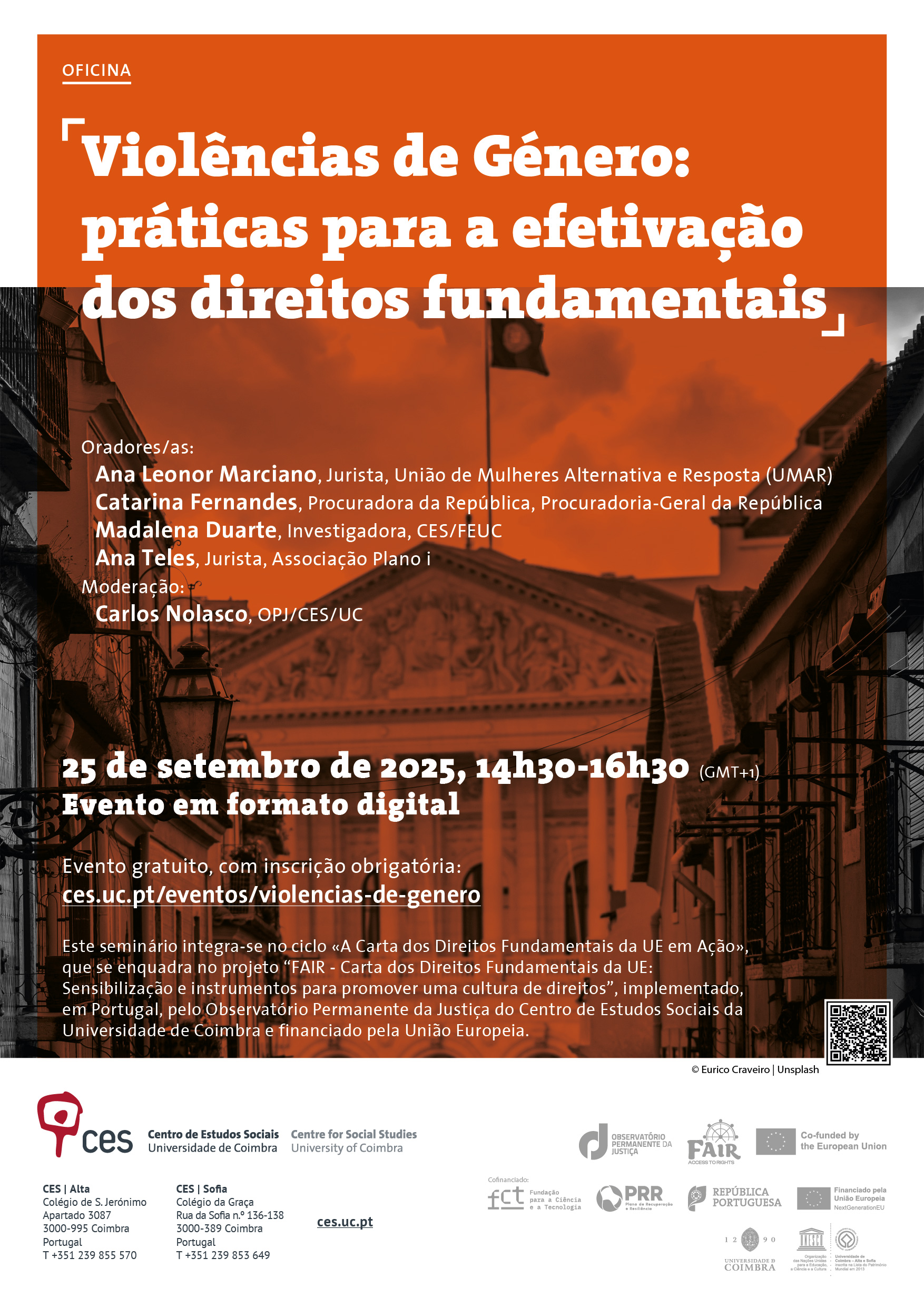

Workshop
Gender-based violences: practises for the enforcement of fundamental rights
September 25, 2025, 14h30-16h30
Online event
The Charter of Fundamental Rights of the European Union is a key legal instrument for promoting human dignity, equality and protection against all forms of violence. In the field of gender-based violences, its adoption has refocused political agendas on the interrelated issues of structural inequality between men and women, violence against women, peer violence and domestic violence. On the basis of the Charter, several legal instruments have been published in the last two decades whose recommendations seek to bring about positive changes in public policies, both at European Union level and developed by Member States, to prevent and combat gender-based violences, which regularly include domestic violence against women, children and young people, recognising it as a serious violation of fundamental rights, a source of inequality and social exclusion, and an obstacle to building a more inclusive society.
Gender-based violences is one of the most serious violations of human rights, affecting women, men and people of non-normative identities, people with disabilities, and children and young people in multiple social contexts. Beyond individual suffering, these practises perpetuate structural inequalities and undermine community cohesion, social justice and democracy. The promotion of spaces for reflection and learning is therefore essential to recognise signs of violence, deconstruct stereotypes and strengthen more robust and effective preventive and intervention responses.
The workshop aims to create an environment for critical dialogue, awareness-raising and the sharing of practical tools, empowering participants to act in a conscious and transformative manner. By mobilising knowledge and experiences, it aims to contribute to the construction of more equitable and secure relationships that respect human dignity and fundamental rights.
Registration is free but mandatory.
Programme
Speakers:
Ana Leonor Marciano, Lawyer, União de Mulheres Alternativa e Resposta (UMAR)
Catarina Fernandes, Public Prosecutor, Attorney General’s Office
Madalena Duarte, Researcher, CES/FEUC
Ana Teles, Lawyer, Associação Plano i
Moderator: Carlos Nolasco, OPJ/CES/UC
Framework
Regular reports from the Commission for Citizenship and Gender Equality (CIG), APAV (Victim Support Association and UMAR (Alternative and Answer Women’s Union), among other documents produced by other entities and associations, continue to show quantitative and qualitative data that substantiate the perpetuation of these phenomena of gender-based violences in multiple contexts. By way of example, and according to data published by the CIG for the first quarter of 2025, 7056 incidents were reported to the PSP and GNR. The National Support Network took in 1412 people (741 women, 649 children and 22 men), 5858 people were covered by tele-assistance, with 1289 restraining orders and 2909 aggressors integrated into programmes. There were also 7 victims of voluntary homicide in the context of domestic violence.
Several studies, such as the one carried out by the Permanent Observatory for Justice (CES/UC) on “Violence against women and domestic violence: evaluative study of measures applied to aggressors”, highlight both the relevance of the justice system’s action in preventing and combating the phenomenon and the need to develop measures that make this action more efficient and effective in protecting victims. The latest report by the Council of Europe’s Group of Experts on Monitoring the Application of the Istanbul Convention (GREVIO) – ‘Building trust by delivering support, protection and justice - Portugal’ – also highlights significant progress in protecting direct and indirect victims of gender-based violence. However, it also points to structural weaknesses, particularly in the judicial system, which limit the effectiveness of the response to these phenomena.
Target audience
This workshop is aimed at all judicial actors (judges, public prosecutors and lawyers) who, in the exercise of their duties, deal with the issue of gender-based violences in its many forms. The workshop is also open to all professionals working in this area, whether in public, associative or private entities. The event is also open to the general public and anyone else who is interested.
Scope
This event is part of the series «The Charter of Fundamental Rights in Action», within the scope of the project «FAIR - EU Charter of Fundamental rights: Awareness raising and Instruments to promote a culture of Rights», implemented in Portugal by the Permanent Observatory for Justice of the Centre for Social Studies.The project is funded by the European Union and implemented in nine Member States, under the coordination of Fondazioni Giacomo Brodolini (Italy).
If you require support in Portuguese Sign Language (LGP), particularly for deaf participants, please send an email to opj@ces.uc.pt by 18h00, 23 September 2025 so that we can arrange for the necessary interpretation.
A certificate of participation will be issued and sent to registered participants who request it after the event, to opj@ces.uc.pt.
For any further information, please contact opj@ces.uc.pt.
Organisers
Permanent Observatory for Justice - Centre for Social Studies of the University of Coimbra
opj@ces.uc.pt
(+351) 239 855 570 / (+351) 914 140 187
https://opj.ces.uc.pt/
.png)