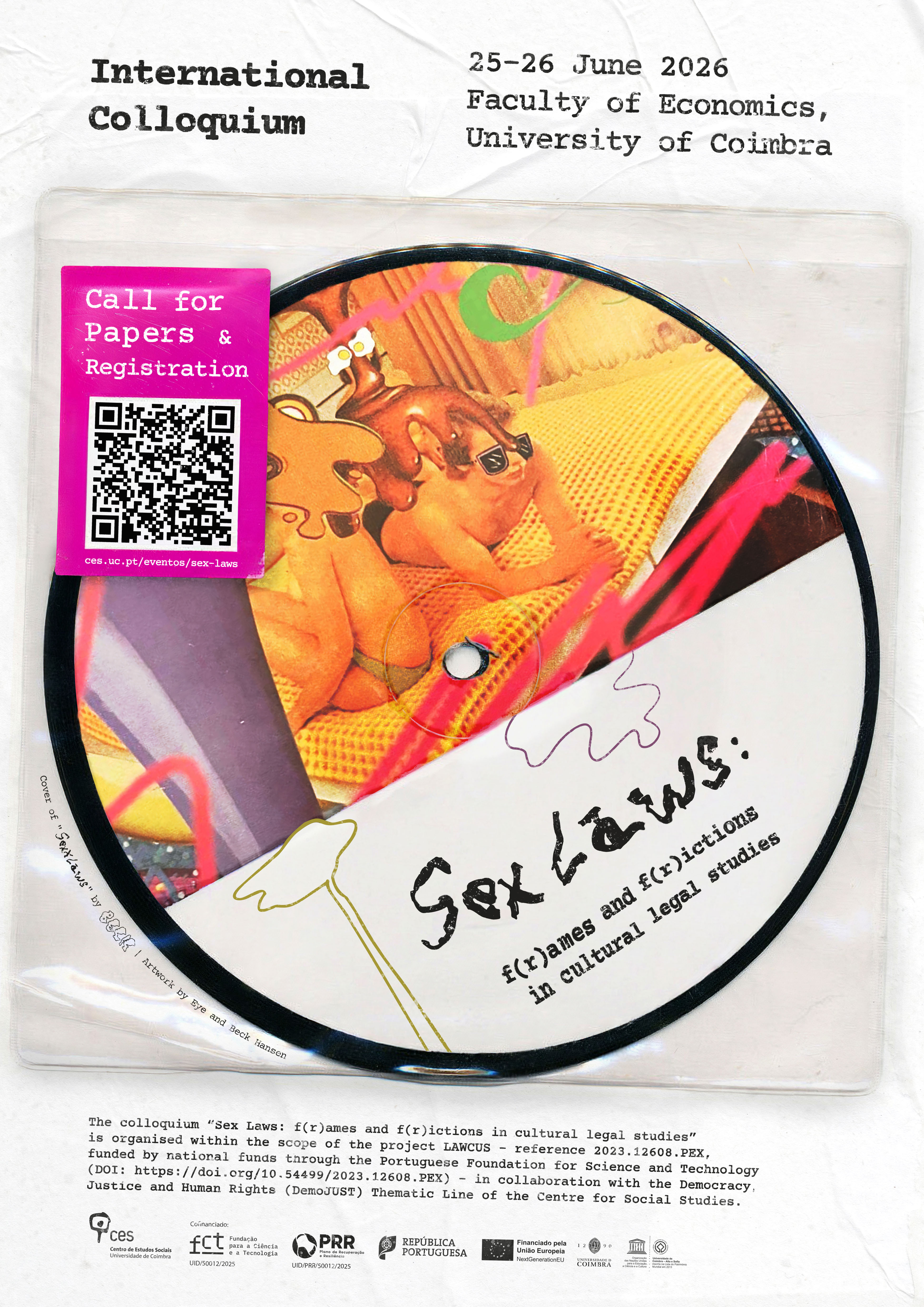

International Colloquium
Sex Laws: f(r)ames and f(r)ictions in cultural legal studies
June 25 and 26, 2026
Faculty of Economics, University of Coimbra
The governance of sexual order and meaning is a theme with a long tradition in social and legal theory, revealing the power of sexual invocation – as violence, emancipation, freedom, self-determination, dignity, danger, etc. – as a way of claiming, justifying or contesting the role of law across different domains of social life.
The international colloquium “Sex Laws: f(r)ames and f(r)ictions in cultural legal studies” has a threefold purpose: to intensify sociological reflection on the legal status of sex by revisiting problems and debates that accompany the preservation and/or transformation of its place within normative and argumentative landscapes; to contribute to the opening and organisation of the archive of resources (ethical, scientific, symbolic, etc.) through which legal practices invest meaning in and represent what they call sex; and to explore how different modes of creative and fictional expression (literary, cinematic, musical) document sexual forms and ideas shaped by legal reason. As a forum for discussion that brings together diverse disciplinary sensibilities, the colloquium seeks to expand the analytical potential of sex as testimony to an equation between will and fate, and to promote, within the Portuguese academic field, a meeting point between cultural studies and the sociology of law.
Building on the sharing of different – and at times unexpected – manifestations of sex in law, the horizon of this event is to outline new hypotheses about law as a cultural phenomenon and sex as a normative challenge.
Registration for the colloquium is free, but mandatory. Participants, with or without a proposal, are welcome to attend sessions, engage with colleagues, and follow the discussions. The deadline for registration is 15 June 2026.
Scientific Committee | Ana Oliveira (CES), António Casimiro Ferreira (CES/FEUC), Brisa Paim Duarte (FDUC/IJ), Elisa Lopes da Silva (IHC-IN2PAST/NOVA FCSH), Inês Brasão (ESTM-IPL/IHC-IN2PAST/NOVA FCSH), Joana Aguiar e Silva (EDUM/JusGov), João Pedroso (CES/FEUC), Jorge Silva Santos (FDUL/CIDPCC), Luís Meneses do Vale (FDUC/IJ), Madalena Duarte (CES/FEUC), Silvia Rodríguez Maeso (CES), Soraya Nour Sckell (CEDIS/FDUNL), Tiago Ribeiro (CES/ESECS-IPL)
Organising Committee | Ana Oliveira (CES), António Casimiro Ferreira (CES / FEUC), Madalena Duarte (CES / FEUC), Tiago Ribeiro (CES / ESECS-IPL)
Important dates:
• Proposal submission: 16 January – 30 April 2026. CLOSED
• Acceptance notification: by 8 May 2026
• Registration opens: 8 May 2026
• Registration closes: 15 June 2026
Contact | For any questions regarding proposal submissions or the colloquium, please contact Ana Oliveira at: anaoliveira@ces.uc.pt
The colloquium “Sex Laws: f(r)ames and f(r)ictions in cultural legal studies” is organised within the framework of the project LAWCUS – reference 2023.12608.PEX, funded by national funds through the Portuguese Foundation for Science and Technology (DOI: https://doi.org/10.54499/2023.12608.PEX) – and the DemoJUST Thematic Line – Democracy, justice and human rights of the Centre for Social Studies.