|
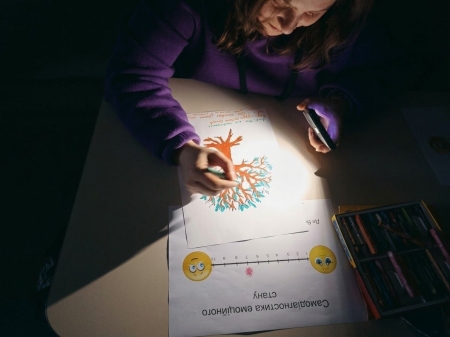
Psychologist Liudmyla Mitsyk conducting an emotional stabilisation session during a blackout in Ukraine. Photo: Liudmyla Mitsyk.
When There Is No Safe Place: How War Changes the Therapeutic Frame
In 2022, after Russia’s full-scale invasion of Ukraine, I joined European colleagues led by Ton de Wijs (the Netherlands) to set up free supervision groups for Ukrainian psychologists, supported by the European Society for Traumatic Stress Studies (ESTSS). In December 2022, during widespread blackouts, one participant wrote: “I’m at a Point of Invincibility right now. I can’t turn on my camera, but I’m with you.” (Points of Invincibility are emergency shelters where people can keep warm and charge their devices during power outages.) When our supervisor, Professor Trudy Mooren, asked, “And how are you?”, colleagues began speaking not only about their clients but about themselves. Some had been forced to leave their homes, some had husbands or children on the front lines, others had lost clients to the war. Later, one colleague lost her son, who was serving in the Armed Forces of Ukraine. We could no longer give the familiar supervisory response: “This is your personal material; take it to your own therapy.” Trudy began opening and closing our meetings with brief stabilisation exercises. We continued discussing cases, but we were also supporting people who were working with others’ trauma while living through their own. After evaluating the programme, the ESTSS4Ukraine organisers described the groups as “more a form of guided intervision” (ESTSS, 2025). Leshem and colleagues (2025) describe a similar reality: among Ukrainian therapists, compassion fatigue and secondary traumatisation coexist with professional growth, while social support serves as an important protective resource. When War Enters the Session During an online session, a Russian attack drone exploded near my colleague’s home. She felt the blast wave and jumped in her chair. Her client, who was abroad, noticed nothing, and the session continued. Was this professional resilience, neglect of her own safety, or a way of preserving normality? There are almost no places in Ukraine where physical safety can be guaranteed, and for many therapists work itself has become a source of stability. The usual advice to take time off is often impossible to follow during a prolonged war. The question is not only how to recover from stress, but how to keep working safely when its source does not disappear. Professional Boundaries and Humanity War has also transformed therapeutic relationships. Therapists and clients have helped each other with evacuation, housing and medical care. When a client asks, “Are you safe right now?”, this is not necessarily material for interpretation; often it is about a real threat, and therapists have increasingly responded with honest, appropriately bounded answers. Palii and colleagues (2025), comparing Ukrainian psychologists’ experiences before and after the full-scale invasion, show how war has reshaped ethical decision-making: psychologists reassess their resources, decide whether to keep working under danger, combine professional roles with volunteering, and reconsider the limits of their competence. Should a therapist continue a session during shelling? Help a client evacuate? Disclose their own danger? Such questions call not for abandoning professional principles, but for adapting how they are applied. The Therapeutic Frame Does Not Disappear; It Changes Garbade and colleagues (2026) capture this dilemma in the title of their study: “When the safe place is not safe”. When neither client nor therapist can be guaranteed physical safety, the psychological safety of the therapeutic relationship becomes especially valuable. We need a professional discussion about adapting the therapeutic frame to a shared traumatic reality: one that acknowledges therapists’ vulnerability, allows carefully considered flexibility in boundaries and responds to real threats while preserving core ethical principles. Ukrainian psychologists are now in their fifth year of working through full-scale war. It is time not only to speak about their resilience, but to study their experience systematically and develop approaches to prolonged crises that may benefit professionals elsewhere.
Tetiana Nazarenko - MA in Psychology, PhD Student at Zaporizhzhia National University, Psychotherapist and EMDR Trauma Therapist.
References European Society for Traumatic Stress Studies. (2025). Call for clinical supervisors to support Ukraine. Retrieved November 20, 2026, from https://estss.org/call-for-clinical-supervisors-to-support-ukraine/ Garbade, M., Hrynova, M., Sachser, C., & Pfeiffer, E. (2026). “When the safe place is not safe”: Therapists’ perspectives on implementing TF-CBT during the war in Ukraine. Child and Adolescent Psychiatry and Mental Health, 20, Article 111. https://doi.org/10.1186/s13034-026-01142-0 Leshem, B., Zasiekina, L., Guterman, N. B., & Pat-Horenczyk, R. (2025). Shared traumatic reality during the continuous war in Ukraine and the protective role of transgenerational transfer: Voices of mental health professionals. Journal of Community Psychology, 53(1), e23161. https://doi.org/10.1002/jcop.23161 Palii, V., Yakushko, O., Chunikhina, S., Solonskyi, A., & Lupis, A. A. (2025). Ethical dilemmas and adaptations in psychological practice during wartime. Ethical Human Psychology and Psychiatry, 27(2), 162–178. https://doi.org/10.1891/EHPP-2024-0019
How to cite this article: Nazarenko, T. (2026). When There Is No Safe Place: How War Changes the Therapeutic Frame. InfoTRAUMA, 46.
|